
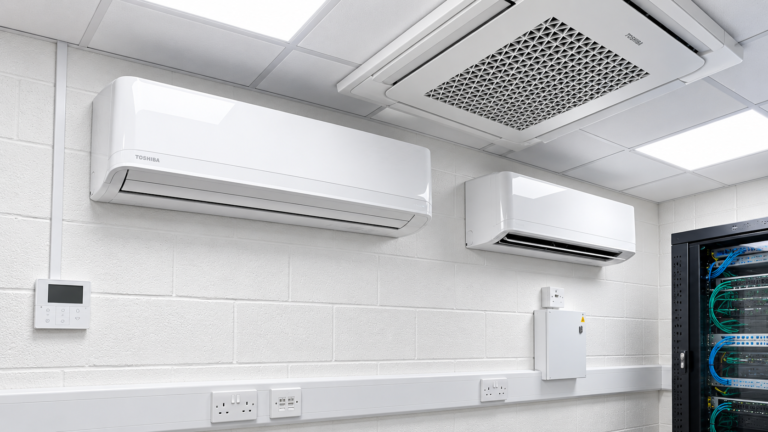
Choosing the right commercial air conditioning system is about far more than keeping a workplace cool.
For businesses across Edinburgh and Central Scotland, a well-designed system can help maintain a comfortable working environment, protect temperature-sensitive equipment and support more efficient building operation throughout the year.
Commercial systems are often more complex than domestic installations, particularly in offices, retail premises, hospitality venues, server rooms and larger multi-zone buildings. The right solution will depend on how the premises are used, the number of occupants, internal heat loads and the level of control required.
At Commercial Temperature Solutions, we design, install and maintain commercial air conditioning systems around the needs of each individual property.
Choosing the Right Commercial Air Conditioning System
There is no single system that suits every commercial building.
A small office may only require one or two split systems, while larger premises may benefit from a multi-split, VRF or ducted solution.
Before specifying equipment, it is important to consider:
- The size and layout of the building
- Number of rooms or individual zones
- Occupancy levels
- Computers, machinery and other heat-producing equipment
- Glazing and solar gain
- Heating as well as cooling requirements
- Operating hours
- Energy efficiency
- Access for future servicing and maintenance
A professional site survey helps ensure the equipment is properly sized and positioned rather than simply selecting units based on floor area alone.
VRF and VRV Air Conditioning for Commercial Buildings
For larger offices and commercial premises, Variable Refrigerant Flow (VRF) systems can provide flexible heating and cooling across multiple areas of a building.
VRV is Daikin’s trade name for its version of this technology.
A single outdoor system can serve several indoor units, with individual areas controlled separately. This is particularly useful in offices where meeting rooms, open-plan areas and south-facing spaces may all have different temperature requirements.
Heat recovery VRF systems can also allow different areas of a building to heat and cool at the same time, transferring heat between zones where the system design allows.
This can make VRF particularly suitable for:
- Larger offices
- Hotels
- Retail premises
- Restaurants
- Healthcare environments
- Multi-storey commercial buildings
- Properties with several independently occupied spaces
Indoor units can include ceiling cassettes, wall-mounted systems and concealed ducted units, giving businesses flexibility over both performance and appearance.
Commercial Air Conditioning for Offices
Comfort matters in the workplace.
An office that becomes excessively warm can be uncomfortable for employees and visitors, particularly where there are large windows, high occupancy levels or significant amounts of IT equipment.
A well-planned office air conditioning system can provide individual temperature control across different areas while avoiding unnecessary cooling of rooms that are not in use.
Modern systems can also provide heating, allowing businesses to use the same equipment throughout much of the year.
Server Room and IT Cooling
Server rooms need careful consideration because IT equipment produces continuous heat, even when the rest of the building is unoccupied.
The correct cooling solution will depend on the size of the room, the equipment installed, its heat output and how critical the infrastructure is to the business.
Rather than assuming that a standard comfort-cooling system will always be sufficient, server room cooling should be designed around the actual heat load and operating requirements of the space.
For business-critical systems, it may also be worth considering resilience or backup cooling so that one system failure does not leave essential IT equipment without temperature control.
Air Conditioning for Retail and Hospitality
Shops, restaurants, cafés and hospitality venues have very different cooling demands from a typical office.
Customer numbers can change significantly throughout the day, while lighting, refrigeration equipment, kitchens and large glazed areas can all add to the heat load.
Commercial air conditioning can help maintain a more consistent indoor environment for customers and staff while allowing different parts of the premises to be controlled separately.
System design is particularly important in these environments because comfort, noise levels, appearance and airflow all need to be considered.
Planned Preventative Maintenance for Commercial Air Conditioning
For commercial operators, waiting until an air conditioning system fails can result in unnecessary disruption.
A planned preventative maintenance (PPM) programme allows equipment to be inspected and serviced at agreed intervals.
Depending on the system and how heavily it is used, maintenance may include:
- Cleaning or replacing filters
- Checking indoor and outdoor units
- Inspecting drainage
- Checking electrical connections
- Reviewing controls and operating settings
- Assessing general system performance
- Identifying signs of wear before they develop into faults
Regular maintenance can help maintain performance, reduce the likelihood of unexpected breakdowns and extend the useful life of the equipment.
The right servicing schedule will depend on the type of premises, the system installed and its hours of operation.
F-Gas Responsibilities for Commercial Air Conditioning
Some commercial air conditioning systems contain fluorinated greenhouse gases, commonly referred to as F-gases.
Businesses operating relevant equipment may have responsibilities relating to leak checks and record keeping depending on the refrigerant and the amount contained within the system. In Great Britain, equipment containing F-gas equivalent to 5 tonnes of CO₂ or more is subject to record-keeping requirements, and mandatory leak-check intervals vary according to the CO₂-equivalent charge and whether automatic leak detection is installed. GOV.UK
Companies carrying out installation, servicing, maintenance or repair of stationary air conditioning equipment containing F-gas must hold the appropriate certification, and individuals handling F-gas require the relevant qualifications. GOV.UK
Refrigerant rules are also changing over time, with restrictions on some higher-global-warming-potential gases in new equipment. This makes system selection and professional advice increasingly important when planning a new installation or replacing older equipment. GOV.UK
Should You Replace an Older Commercial Air Conditioning System?
Not every older system needs to be replaced immediately.
However, replacement may be worth considering if:
- Breakdowns are becoming frequent
- Replacement parts are difficult to obtain
- Energy consumption is high
- The system no longer provides adequate heating or cooling
- The building layout or use has changed
- The refrigerant used in the system is becoming increasingly restricted
- You are refurbishing or expanding the premises
A survey of the existing equipment can help determine whether continued maintenance, partial replacement or a completely new system is the most sensible option.
Commercial Air Conditioning Across Edinburgh and Central Scotland
Commercial Temperature Solutions provides commercial air conditioning installation, servicing and maintenance for businesses across Edinburgh and Central Scotland.
We work with a wide range of commercial properties, from individual offices and retail units to larger multi-zone buildings and specialist areas such as server rooms.
Our approach is to assess the building first, understand how the space is used and then recommend a system that provides the right balance of comfort, control, efficiency and long-term reliability.
Planning a Commercial Air Conditioning Project?
Whether you are fitting out new premises, upgrading an existing system or looking for a more reliable maintenance programme, the first step is understanding what your building actually needs.
Contact Commercial Temperature Solutions to arrange a site survey and discuss the most suitable commercial air conditioning solution for your premises.