
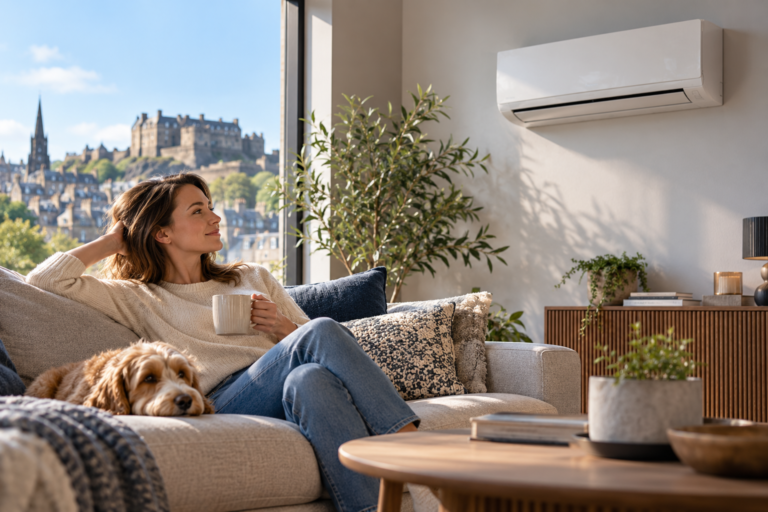
Domestic Air Conditioning FAQs:
Everything Homeowners Need to Know
Thinking about air conditioning for your home? We’ve answered some of the questions homeowners ask us most often about installation, running costs, maintenance and choosing the right system.
If you cannot find the answer you are looking for, simply get in touch with our team.
Is air conditioning suitable for homes in Scotland?
Yes. Modern homes can become surprisingly warm, particularly during the summer months.
New-build properties, loft conversions, conservatories, garden rooms and homes with large windows can retain a considerable amount of heat. Improved insulation is excellent for energy efficiency, but it can also mean that heat takes longer to escape.
Domestic air conditioning gives you much more control over the temperature in your home and can make bedrooms, living areas and home offices far more comfortable.
Can air conditioning also heat my home?
Yes. Many modern domestic air conditioning systems provide both cooling and heating.
They operate using heat pump technology, allowing the system to cool a room during warmer weather and provide efficient heating when temperatures fall.
For this reason, many homeowners use their system throughout the year rather than only during summer.
What rooms can I install air conditioning in?
Air conditioning can be installed in most areas of the home, including:
- Bedrooms
- Living rooms
- Home offices
- Loft conversions
- Conservatories
- Garden rooms
- Open-plan kitchens and living spaces
- Home gyms
The best system will depend on the size of the room, insulation, glazing, orientation and how the space is used.
What type of air conditioning is best for a home?
For many homes, a wall-mounted split system is the simplest and most practical option.
These systems consist of an indoor unit connected to an outdoor unit and are suitable for individual rooms such as bedrooms, living rooms and home offices.
For several rooms, a multi-split system may be more appropriate. This allows several indoor units to operate from one outdoor unit.
Larger properties or renovation projects may also consider ducted air conditioning for a more discreet appearance.
How do I know what size air conditioning unit I need?
Choosing the correct system is not simply about the size of the room.
A professional assessment should also consider:
- Ceiling height
- Window size
- Direction of sunlight
- Insulation
- Number of occupants
- Electrical equipment
- How the room is used
A system that is too small may struggle to reach the required temperature, while an oversized system can be unnecessarily expensive and less efficient.
That is why we recommend a site survey before installation.
Is domestic air conditioning expensive to run?
Running costs depend on the system, room size, temperature setting, insulation and how often the unit is used.
Modern systems are designed to be energy efficient and many use inverter technology, which adjusts the output rather than constantly running at full power.
Using the system sensibly and maintaining a steady temperature can also help keep energy consumption under control.
Is air conditioning noisy?
Modern domestic systems are considerably quieter than many people expect.
Indoor units are designed for residential environments and many models include low-noise or sleep settings, making them suitable for bedrooms and home offices.
Outdoor units also need to be positioned carefully to minimise noise and disturbance.
Can I have air conditioning in my bedroom?
Yes. Bedrooms are one of the most common places for domestic air conditioning.
Upstairs rooms and loft conversions can remain warm long after the outside temperature has dropped, making it difficult to sleep comfortably.
A quiet wall-mounted system can maintain a more comfortable bedroom temperature throughout the night.
Can I install air conditioning in a new-build home?
Yes.
In fact, new-build homes can often benefit greatly from air conditioning because modern insulation and airtight construction are designed to retain heat.
Large areas of glazing can also increase solar gain, particularly in south- and west-facing rooms.
We assess the property before recommending a system so that the installation suits the design and layout of the home.
Can air conditioning be installed in older or period properties?
In many cases, yes.
Older homes may simply require more careful planning around pipework routes, unit positioning and the location of the outdoor equipment.
For traditional or period properties, we aim to keep the installation as discreet as possible while ensuring the system performs properly.
Do I need planning permission for home air conditioning?
Not always, but it depends on the property and where the outdoor unit will be installed.
Flats, listed buildings, properties within conservation areas and homes with particular title or factor restrictions may require additional permission.
It is sensible to check the position before installation, particularly if you live in a flat or a protected property.
Where does the outdoor air conditioning unit go?
The outdoor unit should be positioned somewhere with adequate airflow and access for servicing.
During a site survey, we will also consider:
- Noise
- Appearance
- Access
- Pipework routes
- Drainage
- Distance from the indoor unit
The aim is to find a position that works technically without unnecessarily affecting the appearance of the property.
How long does home air conditioning installation take?
This depends on the number of units and the complexity of the installation.
A straightforward single-room system can often be completed relatively quickly, while multi-room installations naturally take longer.
We will explain the expected installation process before work begins.
Will installing air conditioning make a mess?
A professional installation should involve minimal disruption.
Pipework, electrical connections and drainage all need to be carefully planned, but an experienced installer will aim to keep routes tidy and minimise unnecessary damage to walls and finishes.
We will discuss unit positioning and pipework with you before installation starts.
How often should domestic air conditioning be serviced?
For most residential systems, annual servicing is a sensible starting point.
A system that is used frequently for both heating and cooling may benefit from more regular attention.
Routine servicing allows filters, drainage, airflow and system performance to be checked and can help identify small problems before they become more serious.
Why does air conditioning need regular maintenance?
Regular maintenance can help:
- Keep the system operating efficiently
- Maintain good airflow
- Reduce the risk of unexpected faults
- Keep filters and internal components clean
- Extend the working life of the equipment
- Maintain reliable heating and cooling performance
Maintenance is particularly important if the system is used throughout the year.
Why is my air conditioner leaking water?
A small amount of condensation is normal because air conditioning removes moisture from the air.
However, water should drain away correctly.
If water is leaking inside the room, possible causes include:
- A blocked condensate drain
- A damaged or disconnected drainage pipe
- A faulty condensate pump
- Dirty filters or coils
- An installation or drainage issue
If you notice water leaking from the indoor unit, switch the system off and arrange for it to be inspected.
Why is my air conditioner not cooling properly?
Reduced cooling performance can have several causes.
Common reasons include dirty filters, restricted airflow, incorrect temperature settings or a fault within the system.
If cleaning the filters and checking the settings does not resolve the issue, it is best to have the system professionally inspected.
How often should I clean the filters?
This depends on how often the system is used and the environment within the room.
Most homeowners should check the filters regularly and clean them according to the manufacturer’s guidance.
Keeping filters clean helps maintain airflow and system efficiency.
Can one air conditioner cool the whole house?
Usually not.
A single wall-mounted unit is generally designed to control the temperature within a particular room or open-plan area.
For several bedrooms or multiple areas of the home, a multi-split or multi-room system may be more appropriate.
We can assess the property and recommend a practical solution based on the rooms you want to heat or cool.
Can I control my air conditioning from my phone?
Many modern systems offer Wi-Fi connectivity and app control.
Depending on the equipment chosen, you may be able to adjust the temperature, switch the system on or off and set schedules remotely.
This can be particularly useful for home offices, bedrooms and garden rooms.
What temperature should I set my air conditioning to?
There is no single perfect setting because comfort is personal.
In general, it is better to choose a comfortable, moderate temperature rather than setting the system extremely low and expecting it to cool the room immediately.
A steady temperature is usually more comfortable and can also help the system operate efficiently.
How much does domestic air conditioning cost?
The cost depends on a number of factors, including:
- The number of rooms
- Type of system
- Size of the units
- Installation complexity
- Pipework required
- Outdoor unit positioning
- Additional electrical work
For an accurate price, the best approach is to arrange a survey so the system can be designed around your property.
Do you install domestic air conditioning in Edinburgh and Central Scotland?
Yes.
Commercial Temperature Solutions provides domestic air conditioning installation, servicing and repairs for homeowners across Edinburgh and Central Scotland.
Whether you need a single unit for a bedroom or home office, or a multi-room system for your property, we can help you choose a suitable solution.
Still Have a Question?
Choosing air conditioning for your home does not need to be complicated.
You do not need to know which unit, size or system you require before contacting us. We will assess your home, explain the options clearly and recommend a solution based on your property, lifestyle and budget.
Contact Commercial Temperature Solutions to arrange a home air conditioning survey or discuss your requirements.